March 16, 2026 | Janine Praxmarer
Nobody likes going to hospital. But when we do, we trust doctors to make the right decisions. This trust is one of the most important foundations of our healthcare system.
But time and again, medical errors shake this trust. In recent months, several cases in Austria have made the headlines - cases that show just how dramatic medical errors can be.
But they also raise a bigger question: Is our healthcare system under increasing pressure?
The moment when it becomes clear in the operating room: It's the wrong knee
A case from Tyrol at the beginning of 2026 for great attention. In Innsbruck, a patient was to undergo routine knee surgery - a so-called arthroscopy, i.e. a minimally invasive knee endoscopy.
Such operations are actually part of everyday orthopaedic surgery. But during the operation, the team noticed something that shouldn't happen:
The wrong knee was operated on.
The procedure was stopped immediately and the patient was awakened from the anesthetic. According to the clinic, there were no subsequent health problems. Nevertheless, the incident triggered a great deal of discussion, as there are actually clear safety protocols that are intended to prevent precisely such errors (ORF Tirol, 2026).
These include, for example:
-
Markings on the patient's body
-
Multiple checks of the operation page
-
A so-called „team time-out“ before the start of the procedure
The fact that a mix-up could still happen shows how complex medical procedures are.
Cancer diagnosis - and suddenly your whole life comes to a standstill
Cases involving diagnoses are even more dramatic.
Let's imagine a doctor says: „You have cancer.“
For many people, their world collapses at this moment.
This is exactly what a patient from Styria experienced. She was Diagnosed with lung cancer, a disease that often requires rapid surgery.
The woman decided to undergo the procedure. Part of her lung was removed.
But it turned out after the operation:
The diagnosis was wrong. There was no cancer.
For the patient, this meant not only a serious physical procedure, but also an enormous psychological burden. For weeks, she lived with the fear of a life-threatening illness, only to find out later that it may never have existed.
Such cases show how crucial correct diagnostics are. Error can have particularly serious consequences.
When a medical procedure can no longer be reversed
Other cases from Austria also show how dramatic medical errors can be.
There have been media reports about patients who have undergone serious operations due to incorrect diagnoses, such as organ removal, which later turned out to be unnecessary.
Such errors are particularly tragic because they irreversible are. While many treatment errors can be corrected, operations such as organ removal cannot be reversed.
For those affected, this often has lifelong consequences - physically, emotionally and sometimes also socially.
When the healthcare system reaches its limits
In such cases, the question quickly arises: How could this happen?
Of course, individual errors always play a role. However, many experts point out that medical errors often have systemic causes.
These include, for example:
-
Staff shortages in hospitals
-
Rising patient numbers
-
Time pressure in everyday clinical practice
-
High administrative burden for doctors
An increasing shortage of medical staff has been discussed in Austria for years. Rural regions in particular often lack medical specialists, while at the same time the demand for medical services is increasing.
If medical teams are permanently overloaded, the risk of Probability of error.
One possible solution: new medical professional roles
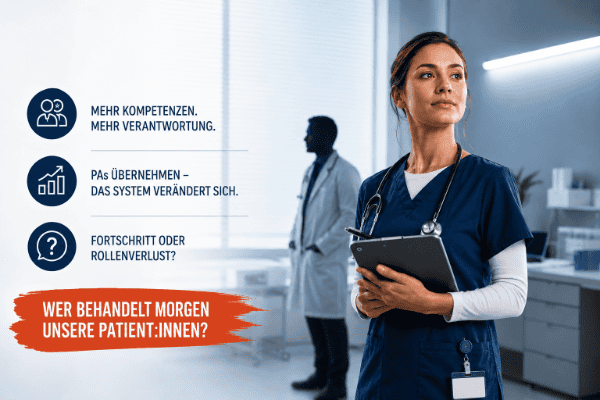
One approach that is becoming increasingly important internationally is the introduction of new medical professional roles - for example Physician Assistants.
Physician assistants are specially trained medical professionals who support doctors in everyday clinical practice.
For example, you can:
-
assist with operations
-
Preparing patient consultations
-
Take over medical documentation
-
Coordinate diagnostic procedures
The idea behind it is simple: if doctors are relieved of some of their workload, they can concentrate more on complex medical decisions.
This division of labor could play an important role, especially in a healthcare system with an increasing shortage of specialists.
Why recruitment is becoming increasingly important in the healthcare sector
In addition to structural reforms, the healthcare system needs one thing above all else: sufficiently qualified personnel.
This is where specialized recruitment agencies come into play. They help medical facilities to fill vacancies with qualified specialists more quickly.
Companies like creaSKILL want to start right here. The aim is to connect hospitals and medical facilities with qualified specialists - about:
-
Doctors and physicians
-
Nursing staff
-
Medical specialists
-
Physician Assistants
Ultimately, the quality of medical care depends heavily on whether there are enough well-trained people working in the system.
Scandals are warning signals - but also an opportunity for improvement
The current cases from Austria clearly show this: Medical errors can have dramatic consequences.
At the same time, however, they also reveal where improvements are needed. More staff, better working conditions and new medical professional roles could help to reduce risks and increase patient safety in the long term.
Because in the end, it's about something very fundamental: Trust.
And this trust only arises when people know that the healthcare system is stable, well organized and adequately staffed.